Pricing StrategyApril 13, 202611 min readNockora Team

How to Test Pricing Changes Before Launch With Decision Simulation

Pricing projects fail when teams treat them like spreadsheet exercises or one-line messaging edits. A stronger approach is to test the move through evidence, scenarios, stakeholder coverage, simulation runs, reporting, and decision follow-through before the new price reaches the market.

Pricing analysisScenario planningForecast review
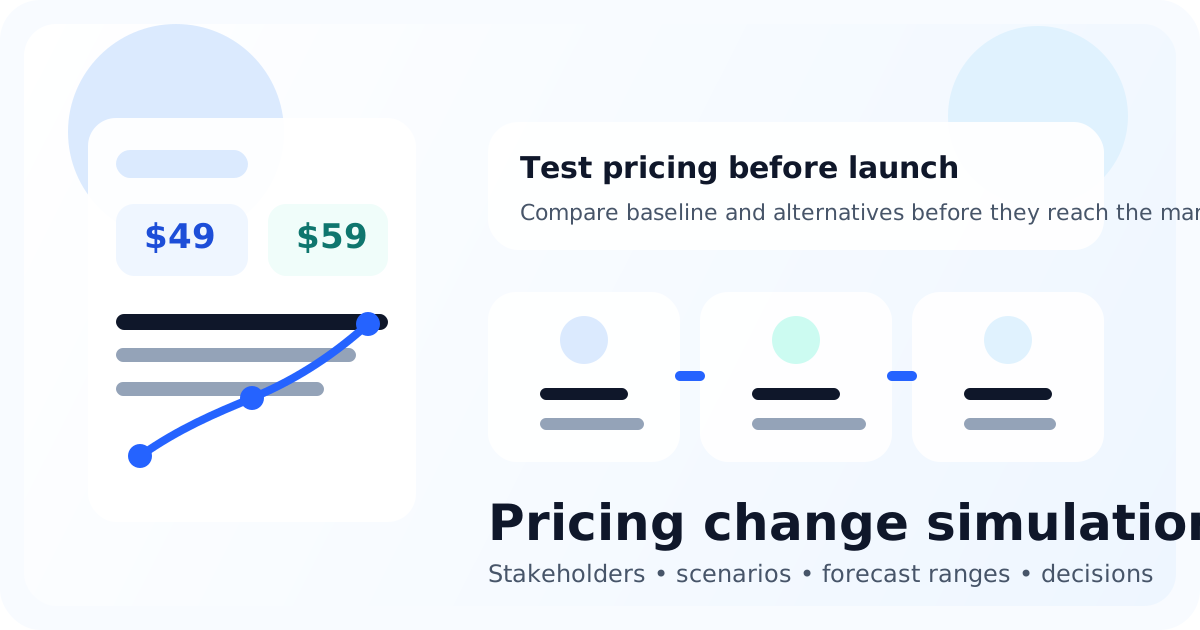
Illustration showing pricing scenarios, stakeholders, forecast ranges, and a decision checkpoint.

Quick answer

To test pricing changes before launch, define the exact pricing move, ground it in source material, compare baseline and alternative scenarios, model the stakeholders who will react differently, run the simulation, review the report, and connect the chosen path to a forecast and decision record. Nockora supports that sequence through workflow setup, reports, forecasts, and the decision ledger.

Why this matters

Pricing decisions rarely change just one thing. A new list price, bundle, plan structure, or billing term can affect positioning, conversion, perceived fairness, customer expectations, and internal confidence at the same time. That is why pricing work often breaks when the team focuses only on margin math or only on launch copy.

A simulation workflow forces those tradeoffs into view earlier. Instead of debating the move in the abstract, the team can define the exact pricing decision, build realistic alternatives, compare stakeholder reactions, and preserve the outcome in a forecast and decision trail. The goal is not perfect prediction. The goal is fewer blind spots before the price change becomes real.

TL;DR

  • A useful pricing simulation starts with one concrete pricing move, not a general question about whether the current pricing is good.
  • The strongest workflow connects evidence, scenarios, personas, runs, reports, forecasts, and decision review.
  • Simulation is most valuable when pricing affects multiple stakeholder groups or when the team needs to compare baseline and alternative structures before rollout.
  • If the pricing move is part of a wider release, pair this workflow with product launch scenario planning.

Why pricing decisions are harder than they look

Revenue is only one part of the move

A pricing change is also a market signal

Pricing projects attract spreadsheets because numbers create the appearance of certainty. The problem is that pricing is also a message about value, positioning, and confidence. A higher price can improve perceived quality for one audience while creating immediate friction for another. A new bundle can simplify buying for prospects while frustrating current customers who no longer recognize the offer they signed up for.

That is why teams need more than a revenue table. They need a way to examine likely reactions, objections, narrative shifts, and operational side effects before the change goes live. Simulation helps because it keeps pricing attached to scenarios and stakeholders instead of isolating it as a purely financial exercise.

Start with one concrete pricing question

Define the move before you test it

A good pricing simulation begins with a decision statement specific enough to compare. The move might be a price increase on one tier, a packaging change, a shift from monthly to annual emphasis, a new premium plan, or a bundle restructure. What matters is that the team can describe the baseline and the alternative clearly enough for the simulation to evaluate the difference.

  1. Write the exact pricing move under consideration.
  2. State the baseline offer and what changes in the alternative.
  3. Identify which customer or stakeholder groups may react differently.
  4. Decide what the comparison should show: risk, likely objections, positioning tradeoffs, or forecast impact.

Without that specificity, the run turns into a broad discussion about pricing strategy instead of a useful pre-launch test. Precision at the start makes the report clearer and the forecast more actionable later.

Ground the analysis in evidence before building scenarios

Use source material instead of selective memory

Pricing teams usually have more context than they realize

Pricing debates often depend on anecdotes. One leader remembers a lost deal. Another remembers a customer who said the product should cost more. Someone else points to a competitor page. A better starting point is to pull together the material that explains the current offer and the reason for the proposed change: pricing pages, sales notes, positioning docs, competitor framing, churn feedback, packaging notes, and internal strategy context.

In Nockora, that begins with uploads and project setup rather than a blank prompt. That matters because the words around pricing often matter as much as the numbers. If the evidence base is sloppy, the output may sound convincing while missing the commercial context that made the decision hard in the first place.

Model the stakeholders who will react differently

Pricing lands differently across audiences

A price change is rarely judged by one audience. Existing customers, new prospects, finance, sales, product leadership, and market observers can all see the same move differently. If the simulation collapses them into one generic persona, the team loses the nuance that makes pricing analysis valuable.

That is why Nockora's verified workflow around persona generation, persona editing, and stakeholder packs matters. It gives the pricing team a way to represent the groups it actually needs to understand instead of relying on a single generalized audience. This is especially useful when the move affects renewals, expansions, new acquisition, and internal messaging all at once.

If the pricing shift is being introduced alongside a release or repositioning effort, bring those dependencies into the scenario instead of pretending they are separate projects. Pricing rarely lands in isolation, which is why launch planning and pricing analysis often belong in the same decision room.

Compare baseline and alternatives before you commit

Pricing becomes useful when the team can contrast paths

A single future is not enough

The value of simulation is comparison. A pricing team does not need one polished report about one vague future. It needs to understand how the baseline compares with a meaningful set of alternatives. That might mean current packaging versus a new bundle, current price versus a moderate increase, or one announcement framing versus another.

This is where scenario setup and run comparison become important. Nockora already exposes scenario management, branching, and compare flows. That gives the team a structure for examining how different assumptions change the likely reaction before a real launch forces the issue.

Use the report to challenge the decision, not just document it

A report is part of the work, not the end of it

A good pricing report should help the team understand what changed between scenarios, where objections cluster, which assumptions seem fragile, and what tradeoffs are becoming visible. It should not serve as ceremonial confirmation for a decision that has already been made.

That is why report chat and follow-up review matter. Teams often discover the value of a simulation when they start interrogating the output instead of treating it as a final verdict. The more a pricing move depends on sequencing, messaging, or market interpretation, the more useful that review step becomes.

Connect the chosen path to a forecast and decision record

Do not let the learning disappear after launch

The strongest pricing process does not end at the report. Once the team selects a path, it should preserve that choice in a forecast and decision record. That makes the expected impact explicit before rollout and gives the organization something concrete to revisit when actuals arrive later.

Nockora's verified product surface includes forecasting, a decision ledger, actual outcome import, and calibration. That means a pricing analysis can stay attached to what happened after launch instead of disappearing into a slide deck. If post-launch review is the gap you are trying to solve, continue with the decision ledger and calibration guide.

Common mistakes in pricing scenario analysis

The same failure patterns show up repeatedly

  • Testing too many pricing changes at once and losing the ability to tell what moved the result.
  • Ignoring existing-customer reaction because the team is focused only on new pipeline.
  • Treating packaging, billing terms, and pricing as separate projects when buyers experience them together.
  • Using a report as a closing artifact instead of as the start of the pricing decision review.
  • Skipping the forecast or decision record, which makes later outcome review much harder.

These mistakes matter because pricing is one of the easiest places for teams to misread confidence as clarity. The discussion sounds decisive, the spreadsheet looks precise, and the market response still surprises everyone. Scenario analysis adds value when it slows the team down enough to inspect the move properly before launch.

The simplest fix is to narrow scope. One pricing decision, one baseline, and a few meaningful alternatives will usually teach the team more than a sprawling multi-variable exercise. Once that operating habit is in place, the workflow can expand without collapsing into noise.

When pricing simulation is worth the extra effort

Use it where the price move has real downside

Not every pricing change needs a heavy decision workflow. The process becomes worthwhile when the move could materially change conversion, retention, expansion, perception of value, or internal execution. If the team is making a cosmetic adjustment that can be reversed quickly, a lighter process may be fine. If the move changes how the market experiences the offer, the extra discipline usually pays for itself.

This is especially true when the pricing change intersects with packaging, positioning, or launch timing. Those decisions can look separate inside the company while feeling like one combined move to customers. Scenario analysis helps the team evaluate the full decision shape before it reaches the market.

Conclusion: run the pricing decision before the market does

Keep the scope narrow enough to inspect

Pricing work gets messy when teams try to solve every monetization question at once. A better first move is one clearly framed decision, one baseline, and a small set of realistic alternatives. That makes the simulation easier to inspect and the downstream forecast easier to use.

If your next challenge is not pricing but a wider launch or go-to-market rollout, the next useful read is Product Launch Scenario Planning. If you are comparing several routes before commitment, go to How to Compare What-If Scenarios Before You Commit.

Frequently asked questions

How do you test pricing changes before launch?

Define the exact pricing move, ground it in relevant evidence, compare baseline and alternative scenarios, model the stakeholders who will react differently, run the simulation, and preserve the chosen path in a forecast and decision record.

Why is pricing scenario analysis useful?

It helps teams pressure-test a pricing move before rollout by surfacing likely objections, reaction differences, and tradeoffs that a spreadsheet alone will miss.

What should be included in a pricing simulation?

At minimum, include the baseline offer, the proposed alternative, the supporting source material, the stakeholder groups most likely to react differently, and a clear comparison objective.

What should happen after the pricing simulation?

The team should review the output, choose a path, create a forecast where relevant, and log the decision so the actual outcome can be compared later.

Keep pricing attached to the rest of the decision workflow.

Nockora gives teams a way to move from pricing scenarios to reports, forecasts, and a decision trail instead of leaving the work in a spreadsheet and a meeting thread.

Keep going with the next workflow step.

Illustration showing launch planning with scenario cards, release timeline, and stakeholder reactions.
Before RolloutInformational / Problem-aware
Launch PlanningApril 13, 202610 min readNockora Team

Product Launch Scenario Planning: A Practical Framework for High-Stakes Releases

Most launch plans look orderly right up until the market sees them. Scenario planning gives the team a structured way to compare baseline and alternative launch paths, pressure-test reactions, and capture the final decision with more discipline than a checklist alone.

Focus: product launch scenario planning

Launch planningScenario designCross-functional review
Read guide
Illustration showing a decision record connected to forecast ranges, outcomes, and a calibration summary.
Decision OperationsInformational / Problem-aware
Decision ReviewApril 13, 202611 min readNockora Team

Decision Log vs Decision Ledger: How to Keep High-Stakes Decisions Reviewable

Teams do not usually lose decisions because no one talked about them. They lose them because the final call, the reasoning behind it, and the expected outcome end up scattered across meetings, reports, and private memory. A decision ledger fixes that by turning one-off judgment into a reviewable operating trail.

Focus: decision log

Decision loggingForecast reviewCalibration loop
Read guide

Article details

Focus keyword
test pricing changes before launch
Search intent
Problem-aware / Informational
Secondary keywords
pricing scenario analysis, test pricing strategy before launch, pricing change risk analysis
Published
April 13, 2026
Updated
April 13, 2026
Reading time
11 min read
Verified scope
Evidence, scenarios, personas, runs, reports, forecast, decisions, and calibration.