Decision ReviewApril 13, 202611 min readNockora Team

Decision Log vs Decision Ledger: How to Keep High-Stakes Decisions Reviewable

Teams do not usually lose decisions because no one talked about them. They lose them because the final call, the reasoning behind it, and the expected outcome end up scattered across meetings, reports, and private memory. A decision ledger fixes that by turning one-off judgment into a reviewable operating trail.

Decision loggingForecast reviewCalibration loop
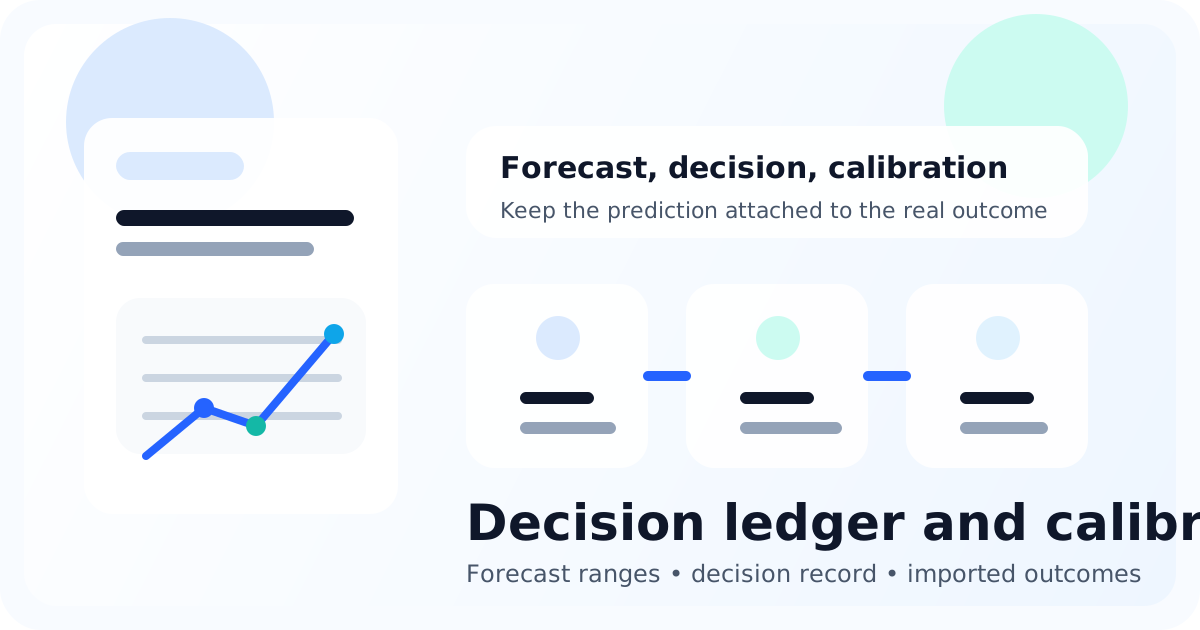
Illustration showing a decision record connected to forecast ranges, outcomes, and a calibration summary.

Quick answer

A decision log records what the team chose and why. A decision ledger goes further by linking that choice to supporting analysis, forecasts, review dates, actual outcomes, and calibration. Nockora's verified workflow includes forecasts, the decision ledger, actual outcome import, and calibration so teams can keep high-stakes calls reviewable after the simulation ends.

Why this matters

The average organization does not have a decision shortage. It has a decision memory problem. By the time a launch, pricing change, or executive call is being judged, the reasoning behind the original choice is often spread across meeting notes, Slack threads, presentations, and a few people's recollection of what they thought would happen.

That is why a decision log matters. But for high-stakes work, a simple list of decisions is not always enough. Teams also need the supporting run, the forecast, the review window, the actual outcome, and a way to compare expectation with reality. That is where a decision ledger becomes more useful than a bare record.

TL;DR

  • A decision log captures what the team chose and why; a decision ledger adds the surrounding workflow needed to revisit that choice later.
  • The most useful ledger entries connect the decision to the underlying simulation or report, the expected outcome, and the review window.
  • Nockora's verified product surface includes decision records, linked forecasts, actual outcome import, and calibration instead of leaving the decision trail in separate tools.
  • If your question is specifically about measuring forecast performance after actuals arrive, continue with Forecast Accuracy vs Forecast Bias.

What a decision log is, and why teams still lose decisions

The problem is not lack of discussion; it is loss of the trail

A decision log is a structured record of what was decided, who made the call, what options were considered, and why the final path was chosen. That sounds simple, but it solves a persistent operational problem. Teams revisit old debates because the reasoning was never preserved in one place that others can review later.

Search results for decision log content often emphasize templates, which makes sense because the intent is practical. People want to know what fields belong in the record and how to use it without creating heavy bureaucracy. That same search intent is why the Nockora blog should answer this question directly instead of blending it into general About-page copy.

What turns a decision log into a decision ledger

The ledger adds the operating context around the call

A ledger is more than a list

A bare decision log tells you what happened. A decision ledger tells you how the decision fits into the wider operating workflow. For high-stakes work, that means linking the decision to supporting reports, forecasts, status changes, review dates, imported outcomes, and calibration results where those exist.

That distinction matters because high-stakes decisions do not live alone. A launch decision may be linked to a simulation run and a revenue forecast. A pricing decision may need a review date and imported actuals. A strategy decision may need a status lifecycle and measurable assumptions. The ledger turns those pieces into one reviewable trail.

What should be recorded in the entry

Keep the structure tight enough to repeat

  • Decision title and short description of the move being approved.
  • The options that were considered and the path that was chosen.
  • Linked supporting work such as a simulation run, report, or forecast.
  • The expected outcome or review window so the team knows how it will judge the call later.
  • Status tracking so the team can distinguish open, measuring, closed, and cancelled decisions.

The right structure is lighter than a project plan but richer than a meeting note. The goal is not to capture every sentence from the discussion. The goal is to preserve the pieces a later reviewer will need in order to understand what was chosen and whether the outcome matched the original expectation.

Why meeting notes and reports are not enough

Documents preserve context, but they do not replace a decision record

Meeting notes describe what was discussed. Reports summarize findings. Neither one, on its own, guarantees that the final decision will remain easy to recover later. Teams still end up asking who approved the move, which alternative was rejected, and what success looked like at the time.

That is why the decision record needs to sit alongside the analysis instead of inside it. Nockora's decision workflows are useful precisely because the ledger can point back to the run or forecast that informed the decision without forcing the user to reconstruct the logic from a long report every time.

How the ledger connects to forecasts and review dates

A decision becomes more useful when expected impact is explicit

A good ledger entry does not stop at the rationale. It also makes the expected outcome visible. That is why forecasts matter. If the team believes a pricing change will have a likely commercial effect within a given measurement window, that expectation should travel with the decision record.

Nockora's verified product surface supports that connection. Decisions can be linked to runs and forecasts, and the ledger includes status and review concepts that make post-decision follow-through more structured. That moves the team away from one-time approval and toward operational review.

Close the loop with actuals and calibration

The decision trail gets stronger when outcomes return to it

A ledger without outcomes is still incomplete

The real value appears when actuals return to the record. If the decision mattered enough to simulate or forecast, it usually matters enough to revisit. That may mean importing observed revenue change, churn change, conversion change, or other decision-specific actuals after a measurement window has passed.

Nockora's calibration workflow exists for exactly that reason. Once actuals are present, the platform can compare forecast and outcome rather than leaving the team with a narrative-only retrospective. That helps the organization learn not just whether the decision worked, but whether its expectations were framed well in the first place.

A simple operating cadence for teams

Keep the loop light enough to survive contact with real work

  1. Complete the simulation or analysis that informs the decision.
  2. Create the forecast if expected impact needs to be explicit before approval.
  3. Log the actual decision in the ledger once the team commits.
  4. Assign a review date or measurement window.
  5. Import actual outcomes and calibrate the result when the window closes.

This cadence matters because decision systems fail when they are too heavy. A lightweight loop repeated consistently is far more valuable than an elaborate framework people avoid. The ledger should help the team remember, review, and learn, not create ceremony for its own sake.

Common mistakes that make a decision ledger useless

The record fails when it is either too light or too heavy

  • Logging only the title of the decision and leaving out the rationale or linked analysis.
  • Treating the ledger as a graveyard of old entries that never receive a review date or status update.
  • Recording every tiny choice, which makes the habit unsustainable and hides the decisions that really matter.
  • Keeping the forecast, the decision, and the actual outcomes in separate tools with no reliable links.
  • Waiting until months later to reconstruct the entry from memory instead of recording it when the decision is made.

The ledger should be strong enough to preserve context and light enough that people will actually use it. When teams get that balance right, the record becomes part of the operating flow instead of an after-the-fact documentation exercise.

Where the ledger should sit in the operating workflow

Close enough to the decision that people will use it

A decision ledger works best when it sits close to the work that produced the decision. If the team has to leave the simulation, open another disconnected system, and manually reconstruct the context, the record habit will usually collapse. The closer the ledger is to the report, forecast, and review loop, the more likely the team is to keep it current.

That is part of why Nockora's workflow matters. The ledger is not positioned as a separate knowledge base. It sits near the simulation, forecast, and calibration flows that give the record its meaning. That design choice makes the decision easier to review later because the supporting context is already nearby.

Who should own updates to the ledger

Ownership matters because review quality depends on follow-through

The ledger does not need a large committee, but it does need clear ownership. Someone has to log the final decision, attach the forecast or supporting work, and make sure the review window is not forgotten. Without a named owner, the record tends to decay right after the meeting where the decision was made.

In practice, that owner is often the operator or strategist closest to the decision workflow rather than the most senior approver in the room. The goal is reliable follow-through, not ceremonial authorship. Once that habit exists, the rest of the team benefits because the record becomes easier to trust and easier to revisit.

Conclusion: the goal is not more documentation, it is better recall

A good ledger keeps the decision reviewable over time

Teams benefit from a decision ledger because it keeps the final call, the supporting context, and the expected outcome together. That makes later review faster and more honest. Without it, the organization ends up reconstructing history from partial artifacts and memory.

If your next question is specifically how to interpret accuracy, bias, and error once actuals arrive, continue with Forecast Accuracy vs Forecast Bias. If you are still working upstream on the decision itself, return to pricing analysis or scenario comparison.

Frequently asked questions

What is the difference between a decision log and a decision ledger?

A decision log records what was decided and why. A decision ledger adds the surrounding workflow such as linked analysis, forecasts, review dates, outcomes, and calibration.

What should be included in a decision log?

At minimum, record the decision, the options considered, the rationale, the owner or approver, and how the team plans to review the outcome later.

Why are meeting notes not enough?

Meeting notes capture discussion, but they often make it hard to recover the final call and its rationale later. A decision log keeps the record easier to find and review.

When does calibration enter the process?

Calibration becomes relevant after the team has actual outcomes it can compare with the original forecast or expected result.

Keep the decision attached to the analysis and the outcome.

Nockora gives teams a connected path from simulation and forecast to decision logging, actual outcome import, and calibration.

Keep going with the next workflow step.

Illustration showing pricing scenarios, stakeholders, forecast ranges, and a decision checkpoint.
Before RolloutProblem-aware / Informational
Pricing StrategyApril 13, 202611 min readNockora Team

How to Test Pricing Changes Before Launch With Decision Simulation

Pricing projects fail when teams treat them like spreadsheet exercises or one-line messaging edits. A stronger approach is to test the move through evidence, scenarios, stakeholder coverage, simulation runs, reporting, and decision follow-through before the new price reaches the market.

Focus: test pricing changes before launch

Pricing analysisScenario planningForecast review
Read guide
Illustration showing predicted versus actual outcomes, error metrics, and calibration bands.
Decision OperationsInformational
Forecast ReviewApril 13, 202610 min readNockora Team

Forecast Accuracy vs Forecast Bias: What Teams Should Measure After a Launch

Forecast accuracy and forecast bias are related, but they are not the same thing. Accuracy asks how close the prediction was to reality. Bias asks whether the team tends to lean too high or too low over time. If you treat those as the same metric, your post-launch learning stays blurry.

Focus: forecast accuracy vs forecast bias

Forecast reviewCalibrationDecision quality
Read guide