Forecast ReviewApril 13, 202610 min readNockora Team

Forecast Accuracy vs Forecast Bias: What Teams Should Measure After a Launch

Forecast accuracy and forecast bias are related, but they are not the same thing. Accuracy asks how close the prediction was to reality. Bias asks whether the team tends to lean too high or too low over time. If you treat those as the same metric, your post-launch learning stays blurry.

Forecast reviewCalibrationDecision quality
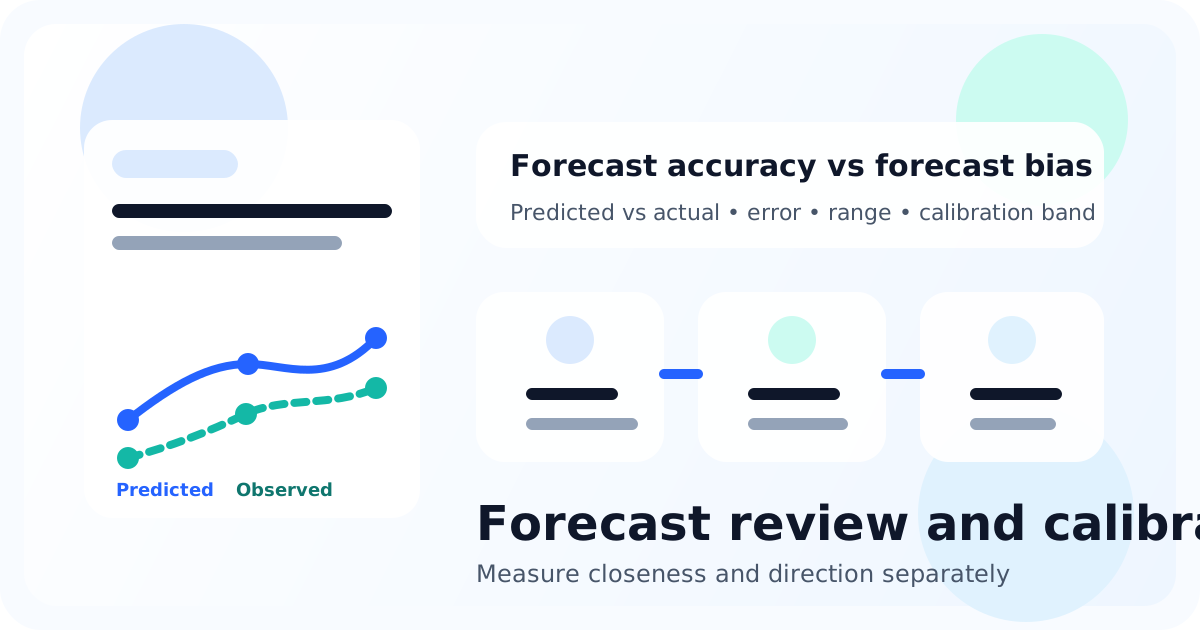
Illustration showing predicted versus actual outcomes, error metrics, and calibration bands.

Quick answer

Forecast accuracy measures how close a prediction was to what actually happened. Forecast bias looks for a pattern of over-forecasting or under-forecasting across decisions. Nockora's verified calibration workflow compares predicted and observed revenue deltas, checks directional accuracy, computes absolute and percentage error, tests whether the observed result landed inside the predicted range, and assigns a calibration band.

Why this matters

Teams often say they want better forecasts when what they really want is better review. A forecast only becomes useful after the team compares it with what actually happened. Until then, confidence and narrative can hide basic problems in the way the organization frames expected impact.

That is why it helps to separate accuracy from bias. Accuracy tells you how close the forecast was. Bias tells you whether the team consistently leans too optimistic or too conservative. Those are different problems, and they point to different improvements in the decision process.

TL;DR

  • Forecast accuracy and forecast bias are related, but they answer different questions.
  • Post-launch review should compare predicted and observed outcomes directly instead of relying on retrospective storytelling.
  • Nockora's verified calibration flow measures directional accuracy, absolute error, percentage error, whether the observed result landed inside the predicted range, and a calibration band.
  • If you still need to structure the decision record itself, pair this with Decision Log vs Decision Ledger.

Forecast accuracy and forecast bias are not interchangeable

They diagnose different problems in the process

Accuracy asks how close

Forecast accuracy is about distance between the prediction and the actual outcome. If the team forecast one result and reality landed very near it, the forecast was relatively accurate. If the actual result landed far away, the forecast was not. The point is closeness, not whether the forecast sounded confident or directionally sensible at the time.

Bias asks in which direction the team tends to lean

Bias looks for pattern. Does the team routinely overestimate upside? Does it consistently understate risk? One forecast can be inaccurate without proving bias. Bias becomes visible when the same directional leaning shows up repeatedly across decisions or over time.

Why teams confuse the two

A single narrative can hide both measurement problems

Forecast review usually happens after a lot of context has changed. Once the launch is live or the pricing change is done, people naturally explain the outcome with a new story. That makes it easy to blur together three different questions: was the direction right, was the magnitude close, and does the team keep leaning the same way across decisions?

If those questions stay mixed together, the team cannot improve the process. It may believe it has a communication issue when the deeper problem is chronic over-forecasting. Or it may think the forecast was fine because the direction was correct even though the magnitude was far off. Better review starts by pulling those questions apart.

How Nockora's calibration workflow measures the gap

The codebase already defines the core review signals

Nockora's calibration service compares predicted revenue delta with observed revenue delta after actual outcomes are imported. The workflow checks whether the forecast got the direction right, how large the absolute error was, what the percentage error looked like relative to the observed result, and whether the actual outcome landed inside the predicted low-to-high range.

  • Directional accuracy: whether predicted and observed moved in the same direction.
  • Absolute error: the size of the gap between predicted and observed values.
  • Percentage error: the size of that gap relative to the observed result when a valid denominator exists.
  • Within predicted range: whether the actual outcome landed between the low and high forecast bounds.
  • Calibration band: strong, acceptable, weak, or insufficient data.

That structure is useful because it separates different types of miss. A team may get direction right while missing magnitude badly. It may produce a reasonable range even when the likely case was off. It may have insufficient data rather than a bad forecast. Those are not the same operational problem.

How to review forecast vs actual after a launch or pricing change

Start with the original expectation, not the new story

The cleanest review starts with what the team originally expected. What outcome did it forecast? What range did it consider realistic? What measurement window did it set? Only after those are visible should the team import actual outcomes and compare them with the prediction.

  1. Pull the forecast and the decision record into the same review.
  2. Confirm the actual outcome and the measurement window.
  3. Check direction first, then error size, then whether the actual landed in range.
  4. Ask what assumption or variable most likely drove the miss.
  5. Capture the lesson so the next decision does not start from zero.

What bias looks like in practice

Bias is a pattern, not a one-off miss

Bias usually shows up as a repeated leaning. A team may repeatedly expect more upside from launches than actually materializes. It may consistently underestimate the reaction to pricing changes. Or it may set forecast ranges that are too narrow because the team prefers certainty to honest uncertainty.

One forecast will not settle that question, but repeated review makes the pattern visible. That is why a decision ledger and calibration loop belong together. Without a stable decision trail, bias remains anecdotal. With a stable record, the team can start seeing where it tends to lean and adjust future assumptions more deliberately.

Use the review to improve the next decision, not to blame the last one

Calibration should sharpen judgment

Post-launch review often turns defensive because people read it as a referendum on the prior decision. A better framing is process improvement. Calibration exists to improve how the team frames uncertainty, sets ranges, and interprets the next forecast. It is a learning loop, not a performance ritual.

That is why the strongest calibration systems feel operational. The team can see the original forecast, the observed result, and the computed gap in one place. Nockora's workflow is built around that operating shape rather than around a standalone spreadsheet or one-time retro.

Common mistakes in forecast review

Most misses get harder to learn from because the review is vague

  • Checking only whether the direction was right and ignoring how far off the magnitude was.
  • Comparing forecasts with actuals long after the agreed measurement window has passed.
  • Treating one miss as proof of bias without looking for repeated pattern.
  • Ignoring the forecast range and reviewing only the single likely case.
  • Turning the review into blame instead of using it to improve the next decision frame.

These mistakes make calibration less useful because they replace measurement with retrospective storytelling. The more explicit the original forecast and review window are, the easier it becomes to learn something durable once actuals arrive.

Why predicted ranges matter alongside the likely case

A good review should examine uncertainty, not just the midpoint

A likely case is useful because teams often need a single planning reference. But the range matters because it reflects how much uncertainty the team believed it was carrying at the time. If the actual result regularly falls outside the predicted range, that is a sign the team may be setting confidence bands too narrowly even when the direction is right.

That is why Nockora's calibration workflow checks whether the observed result landed inside the predicted range as well as calculating error. It gives the team another lens on whether the forecast captured uncertainty honestly, not just whether the midpoint looked close in hindsight.

How often teams should review forecast performance

Tie the review cadence to the measurement window, not to memory

Forecast review works best when the cadence is set at the time of the decision. That might be a launch review window, a pricing measurement period, or another explicit checkpoint tied to the move. If the team waits until someone remembers to ask later, the review becomes slower, less accurate, and easier to rewrite in hindsight.

This is another reason to connect the forecast with the decision record. The team can see when the review is due, what actuals need to be imported, and what result the original forecast expected. That small amount of structure dramatically improves the quality of post-decision learning.

Do not over-read a single calibration result

One review is useful, but repeated review is what changes the process

A single calibration result can still teach the team a lot, but it should not be treated as a complete verdict on forecasting skill. One launch may have unusual conditions. One pricing change may be affected by variables the team could not control. The strongest value appears when review becomes a repeated practice and patterns start to emerge.

That is when bias becomes easier to detect and when calibration bands start to reveal whether the team is improving. In other words, the best use of forecast review is not proving that one prior call was good or bad. It is improving the quality of the next call.

Conclusion: separate closeness from tendency

Accuracy and bias improve together only when the review is explicit

Forecast accuracy tells you how close the team was. Forecast bias tells you how it tends to lean. Both matter, but they solve different diagnostic problems. If the team collapses them into one vague lesson, the next forecast will inherit the same blind spots.

If you need to improve the record around the decision itself, continue with Decision Log vs Decision Ledger. If you are still earlier in the workflow, go back to pricing analysis or what-if scenario comparison.

Frequently asked questions

What is the difference between forecast accuracy and forecast bias?

Forecast accuracy measures closeness to the actual outcome. Forecast bias looks for a repeated tendency to over-forecast or under-forecast across decisions.

What does Nockora's calibration workflow measure?

It measures directional accuracy, absolute error, percentage error, whether the actual outcome landed within the predicted range, and a calibration band.

Why should teams compare forecast vs actual after a launch?

Because the comparison reveals whether the expected impact was framed well and what assumptions or variables may need to change in future decisions.

Can one inaccurate forecast prove bias?

No. Bias is a pattern that appears across repeated decisions or over time, not a conclusion drawn from one miss alone.

Make forecast review part of the operating loop.

Nockora connects forecasts, decision records, actual outcome import, and calibration so teams can review the gap between expected and observed results with more discipline.

Keep going with the next workflow step.

Illustration showing a decision record connected to forecast ranges, outcomes, and a calibration summary.
Decision OperationsInformational / Problem-aware
Decision ReviewApril 13, 202611 min readNockora Team

Decision Log vs Decision Ledger: How to Keep High-Stakes Decisions Reviewable

Teams do not usually lose decisions because no one talked about them. They lose them because the final call, the reasoning behind it, and the expected outcome end up scattered across meetings, reports, and private memory. A decision ledger fixes that by turning one-off judgment into a reviewable operating trail.

Focus: decision log

Decision loggingForecast reviewCalibration loop
Read guide
Illustration showing pricing scenarios, stakeholders, forecast ranges, and a decision checkpoint.
Before RolloutProblem-aware / Informational
Pricing StrategyApril 13, 202611 min readNockora Team

How to Test Pricing Changes Before Launch With Decision Simulation

Pricing projects fail when teams treat them like spreadsheet exercises or one-line messaging edits. A stronger approach is to test the move through evidence, scenarios, stakeholder coverage, simulation runs, reporting, and decision follow-through before the new price reaches the market.

Focus: test pricing changes before launch

Pricing analysisScenario planningForecast review
Read guide