Launch RiskApril 21, 20268 min readNockora Team

How to Reduce Product Launch Risk Before Spending Engineering Time

Launch risk usually starts before a product ships. It starts when teams commit engineering time to a direction that has not been pressure-tested against likely objections, segment reactions, and business downside. A stronger process catches that earlier.

Launch riskRoadmap prioritizationDecision review
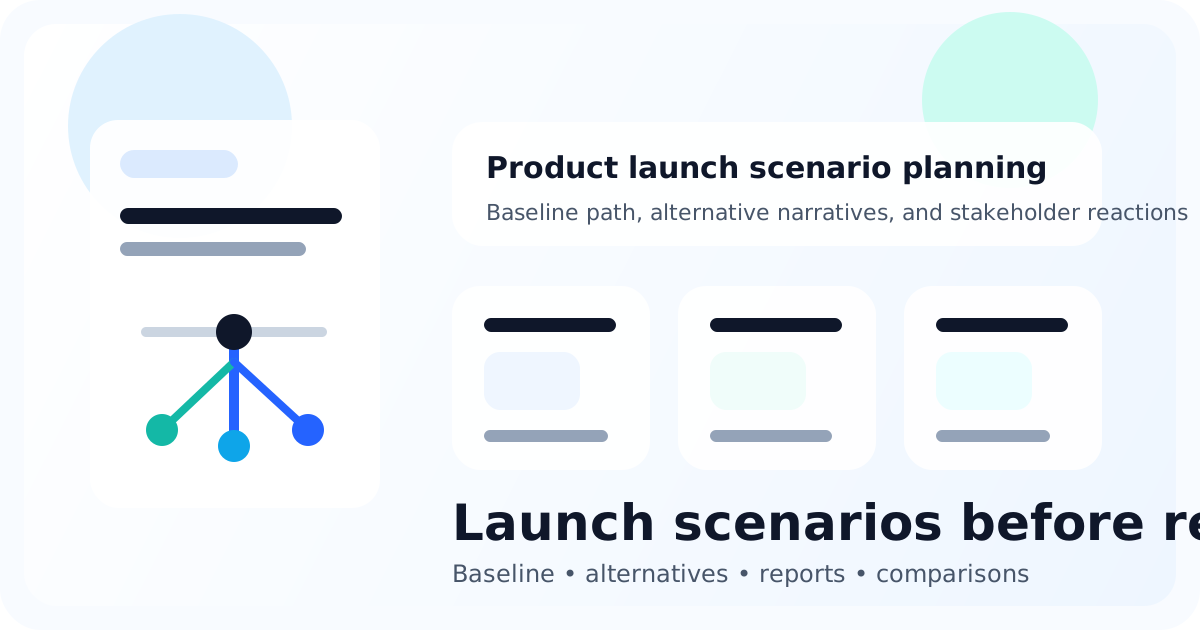
Illustration showing a launch review with risk cards, scenarios, and a go or no-go decision path.

Quick answer

To reduce product launch risk before spending engineering time, define the exact launch decision, identify the segment most likely to reject it, compare rollout paths, and force the team to review downside before it treats the build as inevitable. Nockora's verified surface already supports predict intake, runs, reports, report chat, compare routes, forecast, and decision review workflows that fit this job.

Why this matters

Product teams often say they want to reduce launch risk, but what they usually mean is that they want fewer surprises after shipping. By then the cost is already sunk into roadmap time, QA time, marketing preparation, and leadership credibility. The better move is to pull the risk review earlier, before the build is treated as the default path.

That requires a different workflow. Instead of asking whether a launch idea sounds promising, the team needs to ask what decision it is making, who may object first, what business downside is acceptable, and what evidence would justify moving ahead. That is what turns launch review into decision intelligence rather than pre-launch optimism.

TL;DR

  • Launch risk is easier to reduce before engineering time is locked than after rollout plans are already in motion.
  • The highest-value review frames the decision, names the likely objections, compares scenarios, and produces a memo leadership can challenge.
  • The right goal is not certainty theatre. It is fewer blind spots before budget and roadmap are committed.
  • If the launch depends on a specific feature bet, continue with How to Predict if a New Feature Will Succeed Before Launch.

Launch risk starts at decision quality, not at release day

The earliest mistake is usually the most expensive one

Teams often think of launch risk as a communications problem or an execution problem. Those matter, but the first risk is the decision itself. If the team chooses the wrong scope, wrong segment, wrong timing, or wrong success threshold, later execution will only make the mistake more expensive.

That is why reducing launch risk starts with a pre-commitment review. Before engineering time is fully allocated, the team should know what is being launched, why now, which customer group matters most, and what could make the launch look successful internally while failing in market.

Write the launch decision like leadership would review it

A launch idea needs a yes-no-maybe frame

  1. State the exact launch move under review.
  2. Name the audience or segment that matters most.
  3. Define the upside that would justify the work.
  4. Define the downside that would make leadership regret the decision.
  5. List the alternative paths, such as staged rollout, narrower release, or no launch yet.

This structure matters because launch debates often hide several decisions at once. Scope, timing, segment, pricing, and messaging get blended together. Once those are separated, the team can compare scenarios instead of arguing over a single fuzzy launch concept.

Look for likely rejection, not just likely excitement

The downside path deserves equal weight

Many launches get approved because the internal upside story sounds plausible. That is not enough. The team also needs to review who may reject the move, why that rejection matters, and whether it changes the economics of launching now. Sometimes the biggest problem is not public backlash. It is weak adoption, customer confusion, or internal support burden that makes the launch underperform quietly.

A simulation workflow is useful here because it forces the team to think in reactions, not slogans. Which segment may resist first? Which stakeholder will surface the most serious objection? Where does confidence fall if the evidence is thin? Those are questions a launch meeting often skips when momentum is high.

Compare launch paths before engineering time becomes sunk cost

The choice is rarely launch or no launch

The most realistic decision is often between multiple launch paths: limited beta, segment-first rollout, different packaging, different timing, or a narrower feature surface. Scenario comparison helps because it keeps the team from treating the first proposed launch path as the only credible option.

Nockora's verified workflow already includes scenario, run, and comparison surfaces. That matters because launch risk is usually created by the details of the rollout path, not only by the product itself. A narrow launch with a cleaner message can outperform a broad launch with weaker operational readiness.

Use the output to decide whether the launch deserves more build effort

A pre-launch review should change roadmap confidence

If the review does not change how confidently the team funds the build, it is not doing its job. The output should tell leadership whether the launch should move ahead, be narrowed, be staged, or stop altogether. That means the team needs a verdict, top risks, segment reactions, and a recommended next step that can survive a hard review.

This is where the boardroom memo matters. The memo compresses the reasoning into something leadership can scan: what the decision is, what the likely upside looks like, what could still break, and what the team should do next. That is a real verified surface in the app, not a marketing placeholder.

Business example: enterprise workflow launch with unclear adoption risk

A narrower launch can be the real win

Consider a SaaS team planning to launch an enterprise workflow builder. Product wants broad release. Sales sees upsell potential. Success worries implementation complexity. Marketing wants a headline feature. The pre-launch question should not be whether the workflow builder is exciting. It should be whether the company should launch broadly now, restrict rollout to higher-intent accounts, or hold until onboarding and support materials are stronger.

That framing changes the launch risk profile immediately. The best decision may still be to build. It just may not be to launch the broadest possible version on the first pass.

Actionable checklist before approving engineering time

Use this before the build becomes politically inevitable

  1. Write the launch decision and the alternatives.
  2. Name the segment most likely to reject or ignore the launch.
  3. List the top three downside paths.
  4. Review at least one narrower or staged rollout scenario.
  5. Generate the memo before approving the full launch path.
  6. If commercial impact matters, carry the output into forecast review and later decision tracking.

Conclusion: reduce launch risk when the decision is still cheap to change

The cheapest correction is the one made before the build

Teams rarely regret running a harder review before a launch. They often regret running it too late. The point of decision intelligence is to catch the risky assumptions while the launch is still adjustable, before engineering time, go-to-market prep, and leadership narrative make the wrong path harder to unwind.

If your next challenge is feature-specific, continue with How to Predict if a New Feature Will Succeed Before Launch. If your next concern is campaign or market reaction, continue with How to Simulate Customer Reactions Before Launching a Campaign.

Frequently asked questions

How do you reduce product launch risk before engineering starts?

Frame the launch as a decision, define the top downside paths, compare rollout options, and review the output before the build is treated as inevitable.

What is the biggest source of launch risk?

Often it is not the launch day itself. It is the earlier decision to build and launch the wrong scope, message, segment, or rollout path with too much confidence.

Why compare rollout paths before launch?

Because a staged or narrower rollout can preserve upside while reducing downside, and teams often miss that if they only evaluate one launch path.

Can this process create a memo leadership can review?

Yes. Nockora's verified product includes report generation and a decision memo surface, which is why the workflow can end in a leadership-ready artifact.

Reduce launch risk before the build becomes sunk cost.

Use Nockora to pressure-test the launch decision, compare paths, and create a memo before the business is locked into the wrong rollout.

Keep going with the next workflow step.

Illustration of a product team reviewing feature risks, customer reactions, and decision output before launch.
Before RolloutProblem-aware / Informational
Feature StrategyApril 21, 20269 min readNockora Team

How to Predict if a New Feature Will Succeed Before Launch

Teams usually ask whether a feature will succeed when they are already emotionally attached to shipping it. A better approach is to turn the question into a decision workflow: define the feature decision, identify who could reject it, inspect likely upside and downside, and write the memo before engineering time is fully committed.

Focus: how to predict if a new feature will succeed before launch

Feature launchDecision workflowRisk review
Read guide
Illustration of campaign launch scenarios, customer segments, and reaction analysis cards.
Before RolloutProblem-aware / Informational
Campaign StrategyApril 21, 20268 min readNockora Team

How to Simulate Customer Reactions Before Launching a Campaign

Campaign teams usually find out whether a message works after spend is already live. A stronger process tests likely customer and stakeholder reactions before launch so the team can revise the message, segment, or rollout path before the market does the critique for them.

Focus: simulate customer reactions before launching a campaign

Campaign launchAudience reactionDecision memo
Read guide
Illustration of revenue impact ranges, segment assumptions, and a calibration loop for a product change.
Decision OperationsProblem-aware / Solution-aware
Revenue ForecastApril 21, 20268 min readNockora Team

How to Forecast Revenue Impact Before Launching a Product Change

Most product changes are justified with directional optimism and measured later with regret. A better process estimates likely revenue impact before launch, connects that estimate to the decision memo, and keeps the forecast review tied to actual outcomes later.

Focus: forecast revenue impact before launching a product change

Revenue forecastProduct changeCommercial review
Read guide

Article details

Focus keyword
reduce product launch risk before spending engineering time
Search intent
Problem-aware / Informational
Secondary keywords
reduce launch risk before build, pre-launch product decision workflow, product launch risk analysis
Published
April 21, 2026
Updated
April 21, 2026
Reading time
8 min read
Verified scope
Evidence, scenarios, personas, runs, reports, forecast, decisions, and calibration.