Decision IntelligenceApril 21, 20268 min readNockora Team

How to Evaluate a Business Decision With AI Before Committing Budget

AI is useful for evaluating a business decision only when it improves the workflow, not when it produces more fluent opinions. A serious process frames the decision, pressure-tests likely reactions, reviews risk and impact, and creates a memo before the budget is locked.

Budget decisionsAI workflowDecision memo
Illustration of an AI-assisted decision workflow moving from business question to risk map and memo.

Quick answer

To evaluate a business decision with AI before committing budget, do not ask the model for a final answer. Use AI inside a repeatable workflow: define the decision, identify the audience or stakeholder reactions that matter, compare scenarios, review likely upside and downside, then write the decision memo before spend is approved. Nockora's verified surface already includes predict intake, runs, reports, report chat, forecast, and decision ledger routes that support that process.

Why this matters

AI can make a business decision feel clearer very quickly. That can be useful or dangerous. Useful, because it can surface options, objections, and patterns faster than a blank page. Dangerous, because fluent output can create false confidence before the team has actually reviewed what is at stake.

That is why companies looking at AI for decision support should focus on workflow first. The right question is not "Can AI tell us what to do?" The right question is "Can AI help us evaluate this decision more rigorously before we commit budget, engineering time, or leadership reputation?" The difference is significant.

TL;DR

  • AI is most useful when it improves the decision process, not when it replaces judgment.
  • A budget decision should pass through decision framing, stakeholder reaction review, risk review, memo output, and clear next-step logic.
  • The strongest workflow connects the analysis to later forecast and decision tracking where relevant.
  • If your team is still comparing a generic model workflow against a dedicated decision system, continue with Why ChatGPT Is Not Enough for High-Stakes Business Decisions.

Why teams reach for AI before a budget decision

Speed is attractive when the stakes are high

Budget decisions usually happen under pressure. Leadership wants an answer. Product wants resources. Growth wants to move fast. Finance wants discipline. AI feels appealing because it can synthesize options quickly and make the conversation feel more concrete.

The problem is that quick synthesis is not the same thing as sound decision review. A business move still needs context, stakeholder coverage, explicit downside framing, and a written recommendation that can survive leadership scrutiny. Without that structure, AI output can accelerate the wrong decision just as easily as the right one.

Start with a decision statement leadership would actually approve

Budget requires a clear decision object

  1. Write the exact decision under review.
  2. State what budget or resource commitment is being requested.
  3. Name the audience, customer segment, or business function most affected.
  4. Define what upside would justify the spend and what downside would make it a mistake.

This step is what keeps the process honest. If the team cannot write the decision clearly, it is not ready to evaluate it with or without AI.

Use AI to widen the review, not to close it too early

The model should surface issues the team might miss

At this stage, AI is most useful for expanding the decision surface. It can help identify which segments may object, which assumptions are fragile, where the business impact might show up first, and what scenarios deserve comparison. That is valuable because teams often enter budget conversations too narrow, already defending a preferred answer.

The mistake is treating that first AI output as the conclusion. The decision still needs inspection, comparison, and a path into an actionable memo. That is why a workflow product matters more than a one-screen assistant when the spend is material.

Review stakeholder reactions before the budget is approved

The best business case can still fail if the audience rejects it

Many budget decisions fail because the team overweights the internal business case and underweights the audience reaction. A pricing initiative may look sound in a spreadsheet. A feature investment may look strategically important. A campaign may look compelling on paper. But if the wrong customer segment rejects the move, the budget was committed to the wrong path.

This is why Nockora's verified focus on decision rooms, simulations, reports, memo output, forecast, and ledger workflows matters. The product can be positioned credibly as decision intelligence because it gives the team a way to keep audience reaction tied to the business review itself.

Why ChatGPT alone is not enough for high-stakes budget decisions

The gap is workflow continuity

ChatGPT can absolutely help a team think through a budget decision. It can outline pros and cons, draft success metrics, and suggest objections. But the moment the team needs a repeatable structure with report output, memo generation, scenario comparison, and a decision trail, generic chat starts to show its limits.

That is the core distinction between a useful model and a decision system. Nockora is better positioned as the workflow layer around models. It is not a claim that the underlying model is magically more capable. It is a claim that the business process around the model is stronger and more traceable.

Turn the analysis into a decision memo before budget sign-off

Leadership needs a recommendation, not only a transcript

If the budget is meaningful, the analysis should end in a memo. That memo should include the decision, expected upside, downside risks, confidence, major assumptions, and the next recommended action. A budget meeting goes better when leadership is reviewing a reasoned memo instead of trying to reconstruct the logic from notes and chat logs.

Because the verified app already contains report generation, a decision memo panel, report chat, and forecast/ledger routes, the public-facing copy can now describe a real decision chain rather than a generic insight experience.

Business example: should the company fund an AI workflow initiative?

A common budget decision with several hidden risks

Imagine a SaaS company deciding whether to fund an AI workflow initiative. Product sees differentiation. Engineering sees cost and maintenance risk. Sales expects stronger demos. Finance wants to know whether the initiative can justify the spend this year. Leadership wants to avoid a flashy AI launch that fails to change conversion or retention.

A disciplined review would compare at least two versions of the decision: full initiative now, narrower segment-first launch, or delay until the use case is tighter. That is a much stronger budget process than asking a model whether AI features are strategically important.

Actionable checklist for AI-assisted budget review

Keep the workflow grounded and honest

  1. Write the exact business decision and budget request.
  2. Define upside, downside, and the audience most affected.
  3. Use AI to surface scenarios and objections, not to declare the final answer.
  4. Review stakeholder reactions and commercial impact before approval.
  5. Generate a memo leadership can challenge.
  6. If the decision moves forward, connect it to forecast and decision tracking where possible.

Conclusion: use AI to improve discipline before spend, not to simulate certainty

The right promise is better review quality

The safest and strongest promise around AI budget review is not certainty. It is decision quality. AI can help a team widen the review, compare more realistic scenarios, and write better decision memos before money is committed. That is valuable enough on its own.

If your next question is why a dedicated workflow matters more than generic chat, read Why ChatGPT Is Not Enough for High-Stakes Business Decisions. If the next concern is commercial impact, continue with How to Forecast Revenue Impact Before a Product Change.

Frequently asked questions

Can AI make a budget decision for us?

No. AI can improve the evaluation process, surface objections, and help structure the review, but leadership still owns the final decision.

What should an AI-assisted decision review include?

It should include the exact decision, the budget at stake, likely stakeholder reactions, expected upside and downside, and a memo with a recommended next step.

Why not just use a chatbot for this?

A chatbot can brainstorm, but a high-stakes decision also needs workflow continuity: report output, memo generation, comparison, and a decision trail that leadership can revisit.

Can this help before engineering or campaign spend is approved?

Yes. That is one of the clearest uses. The workflow is most valuable before the budget becomes hard to reverse.

Evaluate the decision before the budget becomes commitment.

Use Nockora to turn one budget-sensitive question into a verdict path, risk review, memo output, and follow-through workflow.

Keep going with the next workflow step.

Illustration comparing generic chatbot output with a structured business decision workflow.
FoundationsComparison / Solution-aware
AI Decision WorkflowApril 21, 20268 min readNockora Team

Why ChatGPT Is Not Enough for High-Stakes Business Decisions

ChatGPT is useful for brainstorming, synthesis, and drafting. The problem is that high-stakes business decisions need more than fluent output. They need structure: a repeatable workflow, segment reactions, risk framing, memo output, comparison, and project decision context. That is the gap a decision intelligence product is trying to close.

Focus: why ChatGPT is not enough for high-stakes business decisions

ChatGPT comparisonDecision workflowSaaS positioning
Read guide
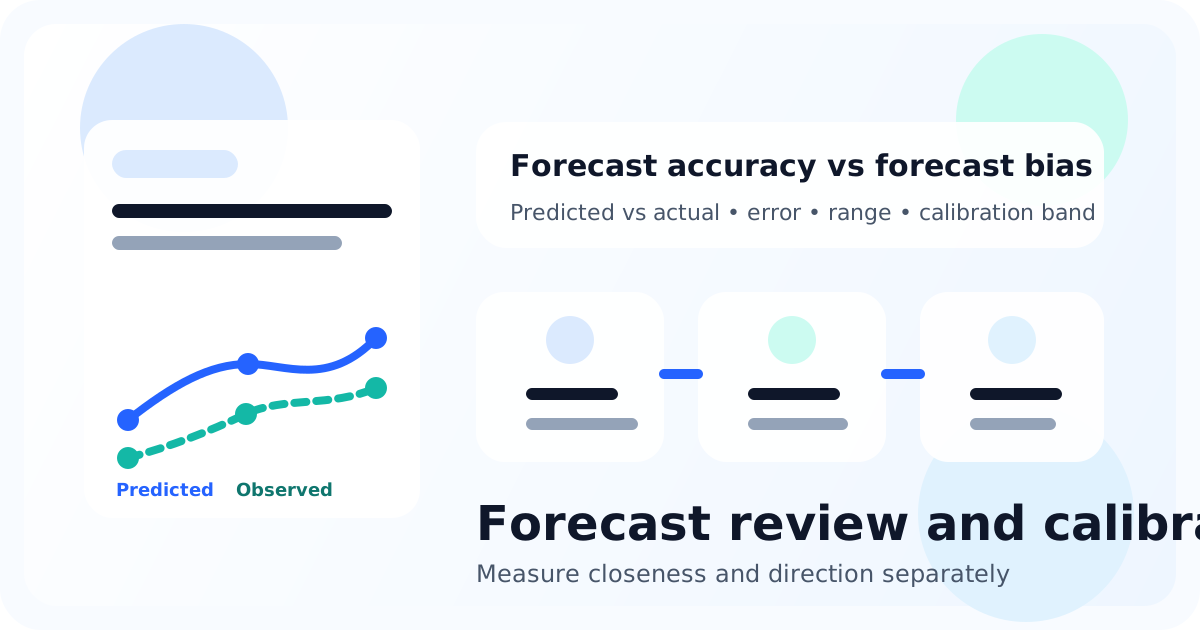
Illustration of revenue impact ranges, segment assumptions, and a calibration loop for a product change.
Decision OperationsProblem-aware / Solution-aware
Revenue ForecastApril 21, 20268 min readNockora Team

How to Forecast Revenue Impact Before Launching a Product Change

Most product changes are justified with directional optimism and measured later with regret. A better process estimates likely revenue impact before launch, connects that estimate to the decision memo, and keeps the forecast review tied to actual outcomes later.

Focus: forecast revenue impact before launching a product change

Revenue forecastProduct changeCommercial review
Read guide
Illustration of a decision memo with verdict, risks, confidence, and next-step sections.
Decision OperationsSolution-aware / Informational
Decision MemoApril 21, 20268 min readNockora Team

How to Create a Boardroom-Ready Decision Memo With AI

A boardroom-ready memo is not a prettier summary. It is the artifact that turns a messy decision process into something leadership can approve, challenge, or stop. AI can help create that memo, but only if the workflow produces the right inputs first.

Focus: create a boardroom-ready decision memo with AI

Decision memoLeadership reviewReport workflow
Read guide

Article details

Focus keyword
evaluate a business decision with AI before committing budget
Search intent
Solution-aware / Informational
Secondary keywords
ai business decision workflow, evaluate decision before budget, decision intelligence before spend
Published
April 21, 2026
Updated
April 21, 2026
Reading time
8 min read
Verified scope
Evidence, scenarios, personas, runs, reports, forecast, decisions, and calibration.